The single most reliable way to lose money trading crypto is to get liquidated. You take a directional view, lever it up, and a perfectly normal-looking wick takes out the position. The view was even right. The size killed you.
Polymarket fixes this by changing the instrument. Instead of a leveraged future with a liquidation price, you buy a binary share — a contract that pays $1 if a specific outcome happens and $0 if it doesn’t. The price you pay is your maximum loss. There is no margin engine, no funding rate, no liquidation. If you have an opinion on where Bitcoin is going, you can express that opinion without the platform ever forcibly closing your trade.
Worth being precise about scope. This is true of Polymarket’s prediction markets — the binary BTC up/down contracts this article covers. Polymarket also runs Perps, a separate perpetual-futures product on crypto, stocks, indices and commodities with funding, margin and liquidation at up to 20x. If you want the no-liquidation property, you want the prediction markets described here; if you want leverage, that is what Perps is for.
I’m not a heavy crypto-perp trader, but I’ve spent time on Polymarket’s BTC markets and the short-horizon ones in particular are genuinely fun. Tight spreads, real volatility, payouts that you can read off the screen. This piece walks through how they work and where they’re a fit.
Why Liquidation Risk Is the Real Problem
A 10x long BTC perp gets force-closed on roughly a 10% adverse move. BTC drops 10% routinely. You can have the right view on a one-week timeframe and still get blown out by a Sunday-night wick that fully reverses by Monday morning. The position closed at the worst possible price; the trader who never got liquidated is unhurt.
This is the asymmetry that perps create. Even when you’re directionally correct, the path to being right has to fit inside your liquidation window — and on a leveraged position, that window is small.
How Polymarket’s BTC Markets Work Instead
Every Polymarket market is a binary share that resolves to either $1 or $0. The price between those two endpoints is the market’s implied probability. On a Bitcoin price ladder, the contract might be “Will BTC close above $80,000 by month-end?” If you buy YES at 30¢, you’re paying $0.30 for a contract that pays $1.00 if it’s true and $0.00 if it isn’t. Your maximum loss is the 30¢. Your maximum gain per share is 70¢.
That’s the whole instrument. There’s no leverage, no margin, no liquidation price, no funding. You buy, you wait, you can sell into the order book any time you want, and the market resolves. (Again: this describes the binary contracts. Polymarket’s separate Perps product does have funding and liquidation.)
Two Flavours: Short-Horizon and Long-Horizon
Short-horizon: 5m, 15m, 1h, 4h and daily up/down markets
The fastest markets on Polymarket are the 5-minute and 15-minute up/down contracts, with the same up/down format also offered on 1-hour, 4-hour and daily expiries. They run on BTC, ETH, SOL, XRP, DOGE, HYPE and BNB. The Bitcoin ones are the most volatile and the most actively traded — at the time of writing, the live 5-minute BTC market shows a 1-cent spread.
That isn’t the tightest spread in crypto in absolute terms — CEX perp books quote in sub-cent ticks all day long. But Polymarket isn’t a perp; it’s a binary derivative. On a contract that prices between 0¢ and 100¢, a 1-cent spread is the entire book compressed into 1% of implied probability. Binary options on most prediction markets are quoted with 5- or 10-cent spreads. Getting to a single cent on a binary outcome is genuinely impressive for the format, and it only happens because crypto is the highest-volume vertical on the platform.
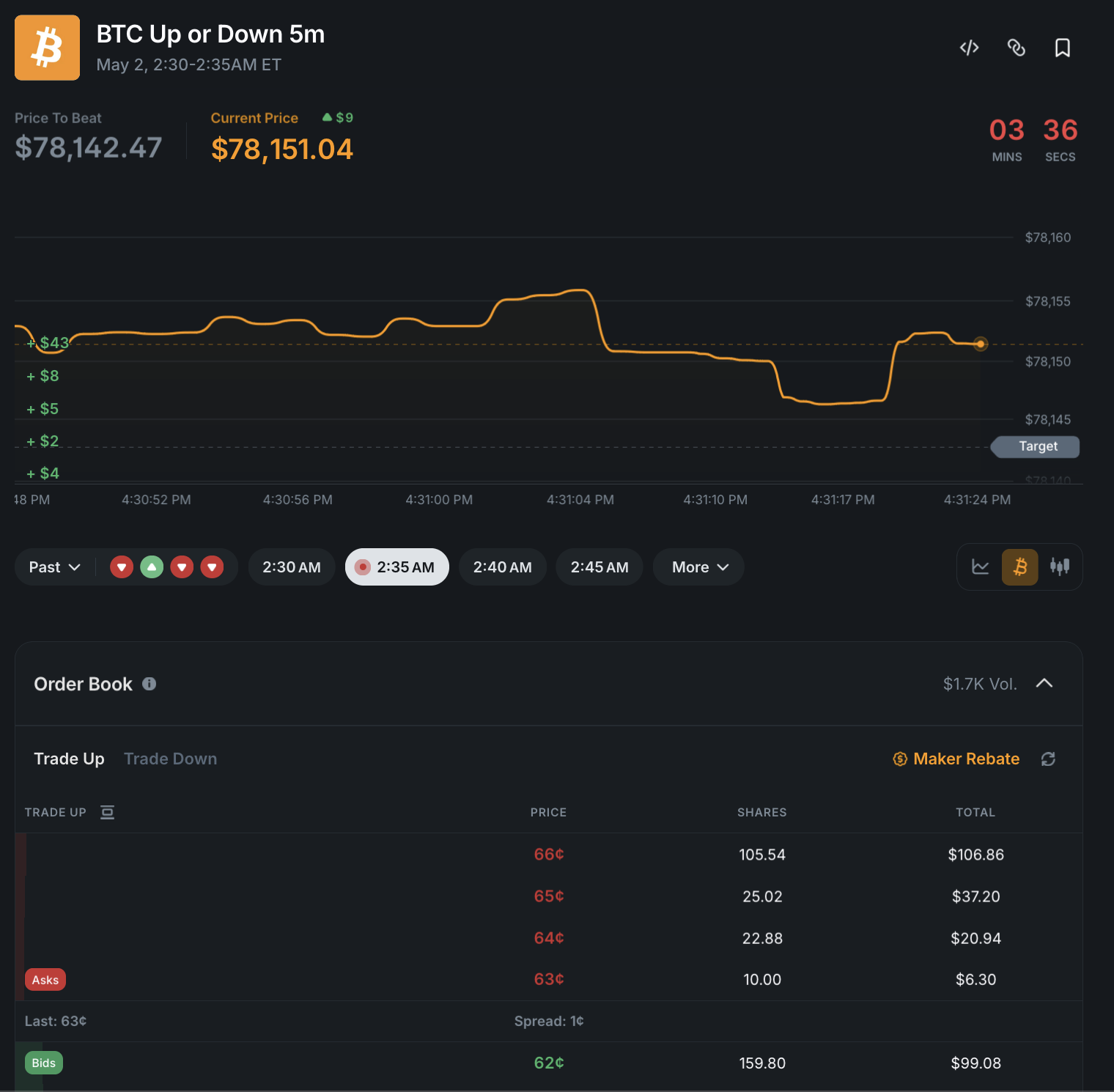
The price ticker, target line, time-to-expiry and full order book are all visible at once. The orange line is the BTC spot, the dashed line is the target. With minutes to go, every tick on spot is repriced into the YES/NO market. It’s the cleanest expression of “do you think BTC closes higher or lower than this number” that exists on-chain.
Long-horizon: weekly, monthly and yearly ladders
If short-horizon scalping isn’t your thing, the longer-dated BTC ladders ask the same question over much longer windows. “Will BTC be above $X by end of month?” “What price will BTC hit before 2027?” These markets clear hundreds of millions of dollars in monthly volume; the year-end 2026 BTC market alone holds $34.5M of volume.
The same rules apply. You pay between $0.00 and $1.00 for a YES share, your downside is the price, you can exit any time.
The 1-Tap Feature: Trading at the Speed of a Perp Without the Risk
Polymarket recently added 1-Tap mode to the order panel. Instead of filling out a limit-order form, you pick a preset size — $1, $5 or $100 by default, and you can edit them — and the order fires at the best available price. It’s purpose-built for short-horizon markets where you’ve spotted a setup with thirty seconds left and don’t want to faff around with shares-and-price arithmetic.
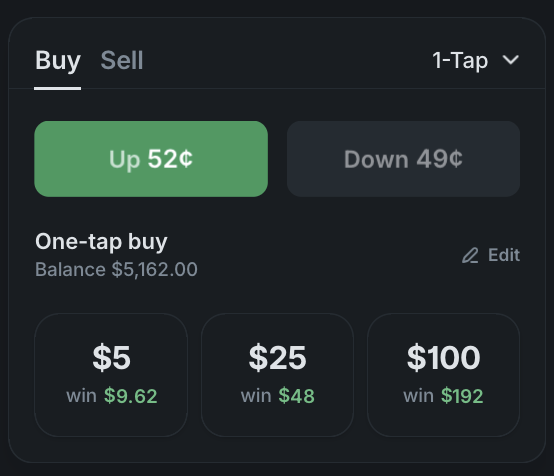
Crucially, the panel shows you the payout before you click — every quick-size button displays the exact amount it returns if the market lands your way. The exact-payout-on-screen design is the thing perps don’t have — there, you’re left to compute your own R-multiple from leverage, entry and target.
Try the 1-Tap BTC MarketsSide-by-Side: $100 Long BTC Perp vs $100 of “BTC Up” YES
Take the same view: you think BTC is going up over the next hour.
Hyperliquid (10x perp on $100 collateral):
- Notional position: $1,000
- Liquidation price: roughly 10% below entry
- Best case: directional move pays out as a multiple of leverage
- Worst case: if BTC ticks down ~10% during the hour, the position is closed and the $100 is gone
Polymarket (5-minute “Up” YES at 52¢, $100 size):
- Shares bought: ~192
- Best case: BTC closes above the target, you collect $192 (a profit of $92)
- Worst case: BTC closes below, your shares resolve to $0 — you lose the $100
- During the contract: you can sell into the order book any time at the prevailing price
The Polymarket version has a smaller best-case multiple, but the worst case is bounded by the position size and there’s no path-dependency. A wick down to ten dollars below the target and back up doesn’t take the position out — there is no liquidation price to hit. Note the one exception to the “only the close matters” idea: markets resolved by Chainlink TWAP settle on an average over a window rather than a single closing print, so on those, intra-window moves do count.
The Mental Model: Price Is Probability, Payout Is on Screen
The thing crypto traders coming over from perps tend to undervalue is how much information the order panel hands you. Every share has a price between $0.00 and $1.00. That price is the implied probability. The payout — what you’ll receive if you’re right — is shown directly in the buy box.
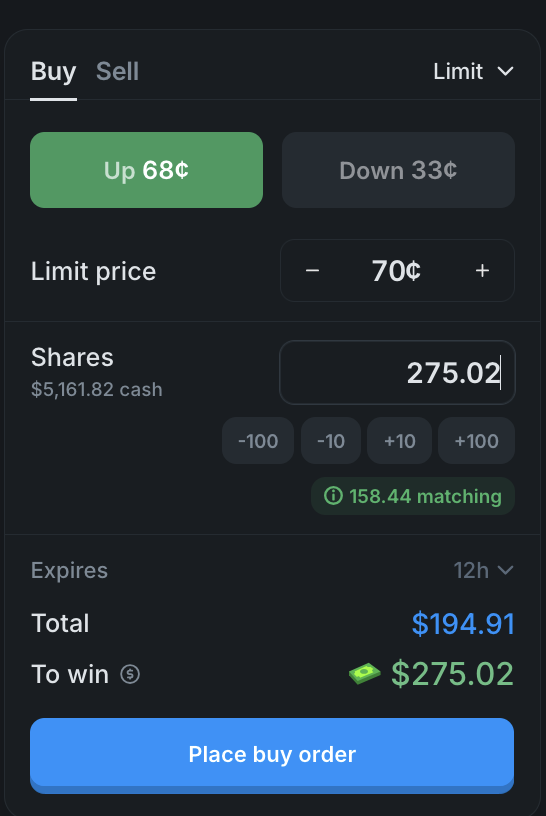
In this screenshot the trader is buying 275 shares at 70¢ for a total of $194.91. The “To win” field shows $275.02 — the exact dollar amount they collect if the market resolves YES. There’s no R-multiple to compute, no funding rate to amortise, no maintenance margin to track. The number on screen is the number you get.
You Can Exit Whenever — This Matters More Than People Realise
Every Polymarket market lets you trade in and out at will. You don’t need to hold to resolution. If you bought at 30¢ and the market is now at 70¢ with three days left, you can sell the position immediately and lock in the gain. Conversely, if your view changes, you can cut the position before resolution and recycle the capital into the next idea.
This is the same flexibility a perp gives you, without the liquidation risk that comes with the leverage.
When Short-Horizon Ladders Are Not the Right Tool
Be honest about the trade-offs.
- You want leverage. Polymarket can’t lever you up. If your edge requires a 5x or 10x payout on a small directional move, perps still do that better.
- You want to trade the long tail. Polymarket’s short-horizon up/down markets cover the majors — BTC, ETH, SOL, XRP, DOGE, HYPE, BNB. If you want to scalp memecoin or low-cap perps, Hyperliquid has hundreds of pairs Polymarket doesn’t.
- You need a precise dollar-delta to spot. A binary contract pays the same $1 whether BTC closes a dollar above the strike or ten thousand dollars above it. Magnitude isn’t priced in.
For directional speculation on Bitcoin (and ETH and HYPE) without liquidation risk, though, Polymarket’s BTC markets are genuinely the cleanest tool I’ve used.
Related
- Polymarket vs Hyperliquid — The full platform comparison
- Polymarket for Crypto Traders Who’ve Never Used It — 10-minute setup
- News Trading on Polymarket — Pairs well with Fed and ETF announcements
- How to Trade on Polymarket — Order types and execution
- Polymarket Fees Explained — Why crypto is the highest-fee category (and how makers pay zero)
- Fee Calculator — Compute exact fees before you trade