Until recently, investing in a private company meant one of a few things: working there and earning equity, being an accredited investor with access to a venture fund, or buying shares on a secondary marketplace like Forge or EquityZen — usually with high minimums, lockups, and an accreditation check. For everyone else, the most valuable private companies in the world were simply off-limits until they IPO’d.
Polymarket has opened a side door. It now runs valuation markets on private companies — letting you take a position on whether OpenAI, SpaceX, Anthropic and others will hit a given valuation by a set date. No accreditation, no lockup, no five-figure minimum. This guide explains how those markets work, how they resolve, and how to use them.
What Are Private Company Valuation Markets?
A private company valuation market asks a simple question: will this company’s valuation reach a specific number by a specific date?
Take Anthropic. Instead of one market, you get a ladder of thresholds — markets for “$1.5T by December 31”, “$2.0T by December 31”, “$2.5T by December 31”, and so on, plus downside thresholds for valuations below the current level. Each rung is its own Yes/No market. You buy Yes if you think the valuation reaches that threshold, No if you don’t.
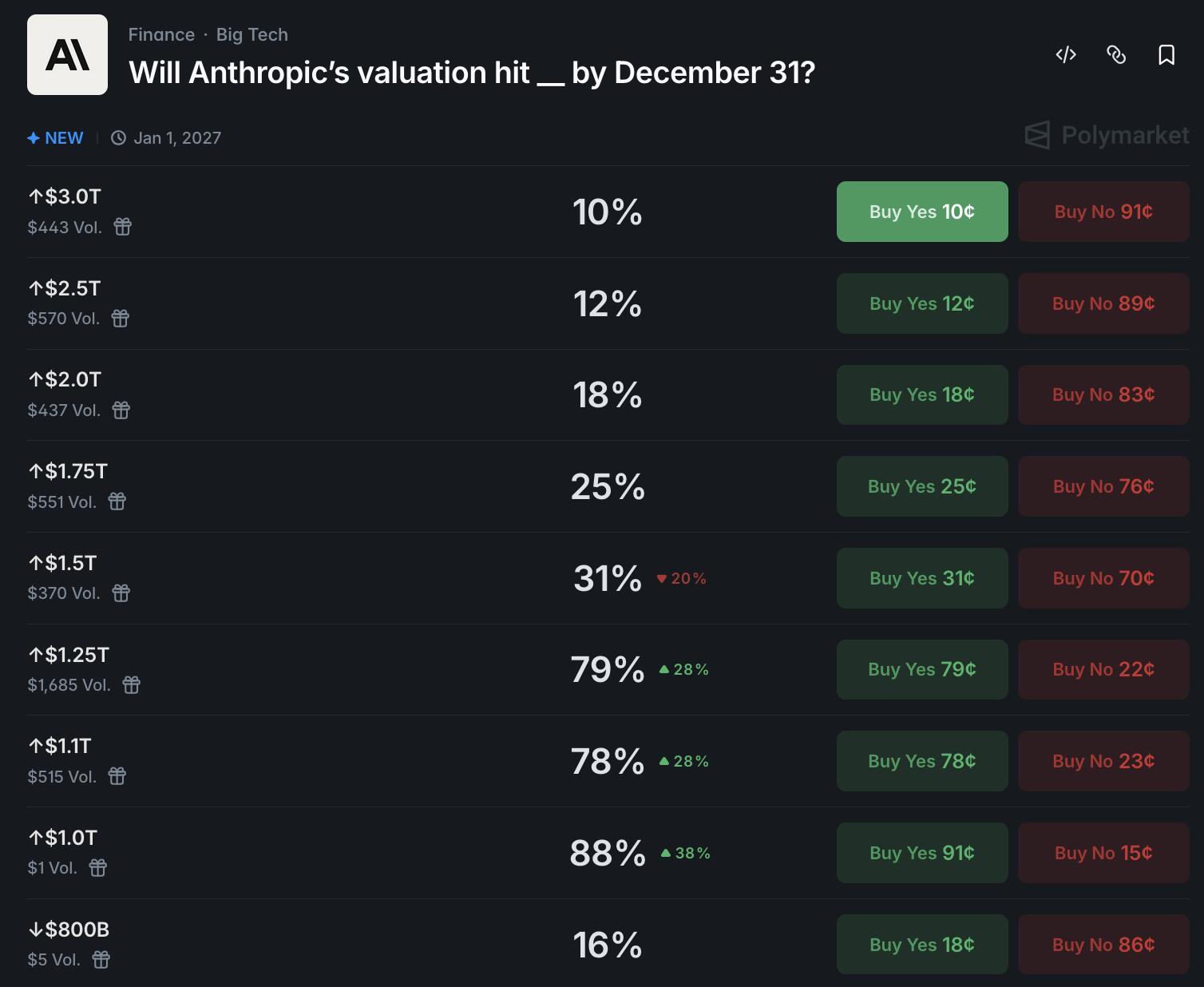
In the screenshot above, the year-end Anthropic market shows the full ladder. The “$1.0T by December 31” threshold trades around 88¢ — the market thinks it is very likely. The “$2.0T” threshold trades around 18¢ — possible, but a long shot. The price is the probability: an 18¢ share means the market puts roughly an 18% chance on that outcome. If you are new to that idea, our guide to understanding odds on Polymarket covers it in full.
Polymarket currently runs these ladders at two horizons — a mid-year resolution and a year-end resolution — so you can take a short-dated or longer-dated view on the same company.
Where the Valuations Come From
The reference valuations are sourced from Nasdaq Private Markets (NPM), updated daily. NPM is one of the most established venues for private-company secondary trading, so the underlying number is about as reliable a private-company valuation as exists.
The market page links out to the NPM valuation directly — click through and you can see the figure the market is built around. That transparency matters: you are never guessing what “fair value” is, you are trading around a published, daily-updated reference.
One thing to keep in mind: NPM updates daily, not tick-by-tick. The share price on Polymarket moves continuously as traders buy and sell, but the underlying valuation it references refreshes once a day. Most of the time that is plenty — private-company valuations do not whipsaw the way a stock does — but it is worth knowing.
How These Markets Resolve
Each threshold resolves independently, and it resolves as soon as the threshold is met.
If a market asks whether Anthropic hits $2.0T by December 31, and the NPM valuation crosses $2.0T in August, that market can resolve Yes in August — you do not wait for the deadline to get paid. If the threshold is never reached, the market resolves No at the deadline.
Resolution itself runs through the UMA Optimistic Oracle, the same mechanism that settles every other Polymarket market. Anyone on the proposer whitelist can propose the outcome, a challenge window opens, and if nobody disputes it the result finalises. If you want the full mechanics, see how Polymarket markets resolve and how to propose resolutions.
Which Companies Are Available
At the time of writing, Polymarket has valuation markets for twelve private companies:
- AI & data: OpenAI, Anthropic, Perplexity, Databricks, Lambda
- Space & defense: SpaceX, Anduril
- Fintech: Stripe, Kraken
- Other: Neuralink, Epic Games, Canva
There is no dedicated “private companies” hub on Polymarket yet. To find a market, just search the company name in the search bar — or search “private company” and the full set comes up.
How to Get Exposure to Anthropic (Worked Example)
Say you think Anthropic’s valuation will climb past $1.75T by year-end. Here is the flow:
- Search “Anthropic” on Polymarket and open the year-end valuation market.
- Find the $1.75T threshold on the ladder. In the screenshot it trades around 25¢.
- Buy Yes. At 25¢ a share, $250 buys you 1,000 shares.
- If the NPM valuation hits $1.75T before December 31, the market resolves Yes and each share pays $1.00 — your $250 becomes $1,000.
- If it does not, the market resolves No and the shares expire worthless.
You do not have to hold to resolution. Like any Polymarket market, you can sell back into the order book any time the price moves your way and book the gain early.
Sign Up and Start TradingMy take: I have personally placed bets on the Anthropic market. What I love is how easily you can get exposure to a company like Anthropic without going through the usual private-market hurdles — no accreditation, no broker, no minimum ticket size. It takes a couple of minutes. The one thing I would flag is liquidity (more on that below), but for getting a position on a private valuation, nothing else is close to this quick.
How This Compares to Investing in Private Companies the Traditional Way
The conventional routes into private companies — accredited-investor funds, pre-IPO marketplaces like Forge and EquityZen, or employee equity — all involve some combination of accreditation requirements, large minimums, lockup periods, and a slow settlement process. They also give you actual equity.
Polymarket gives you none of the equity and none of the friction. You will not get dividends, voting rights, or a cap-table position — what you get is a fast, accessible way to express a view on a valuation. Think of it as exposure to the direction of a private valuation, not ownership of the company. For most people who simply want a position on whether Anthropic or SpaceX keeps climbing, that distinction does not matter much. Just be clear about which one you are buying.
Limitations and Risks
These markets are genuinely useful, but they are not without rough edges. Going in honest:
- Liquidity is the main one. These markets are newer and thinner than Polymarket’s flagship political and crypto markets. Polymarket currently pays liquidity rewards to market makers to improve depth here, which helps — but you still cannot move tens of thousands of dollars in or out without slippage. Check the order book before you size a position, and use limit orders if you are trading size.
- Daily pricing, not live. The NPM reference valuation updates once a day. The traded price moves continuously, but the underlying number it tracks does not.
- You do not own equity. No dividends, no voting, no upside beyond the binary payout. It is a contract on a valuation threshold, not a share.
- Resolution depends on a published valuation. Settlement leans on the NPM figure and the UMA oracle process. That is robust, but it is one more dependency than a market that resolves on a plain public fact.
- Close-only in the US. Private company markets follow the same geography as the rest of the international Polymarket exchange: close-only in the US (existing positions can be closed, but no new trades opened), close-only in the other close-only jurisdictions, and available wherever the international exchange is available. Check the country availability page or the country checker if you are unsure.
How to Start
- Sign up and fund your account. If you do not have an account yet, how to sign up and how to deposit cover it — there is no KYC and no accreditation check.
- Search for the company. Type the company name or “private company” into the search bar.
- Pick a threshold and date. Choose the rung of the ladder that matches your view, at the mid-year or year-end horizon.
- Place your trade. Buy Yes or No. If you are new to order types and the order book, how to trade on Polymarket walks through the mechanics — and on thinner markets like these, limit orders are your friend.
Related Resources
- How to Sign Up for Polymarket — Create and fund an account in minutes
- How to Trade on Polymarket — Order types, limit orders and the order book
- Understanding Odds on Polymarket — Why the price is the probability
- How Polymarket Markets Resolve — The UMA Optimistic Oracle process
- Fundamental Analysis Strategy — Research-driven trading that fits valuation markets well
- Polymarket Review 2026 — Full platform review after 3+ years of trading