Compute futures let you trade the price of AI computing power: what it costs to rent an Nvidia GPU for an hour. Polymarket now lists them under a Compute tab, with monthly markets on the rental prices of the H100, B200 and B300 running out to December 2028. You can bet on GPU rental prices rising or falling, or hedge a compute bill you already have.
I think these are some of the most interesting markets Polymarket has launched. Compute is turning into a commodity, like oil or power, and this is one of the first places anyone can trade its price.
What Polymarket’s Compute Markets Are
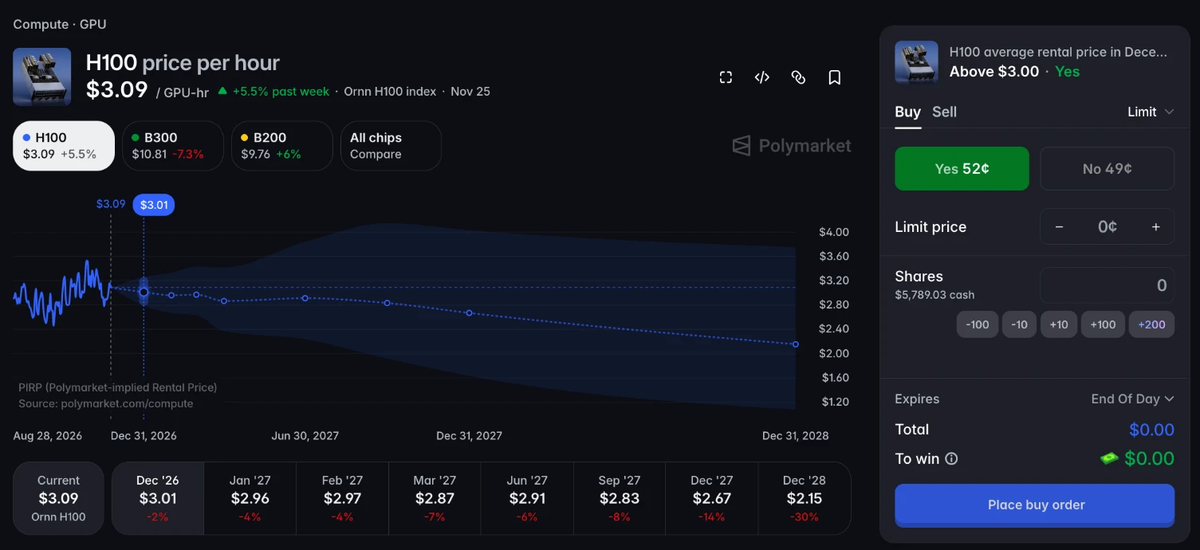
Each GPU has a market for each month: for example, “H100 average rental price in January 2027?”. Inside it is a ladder of strikes, each its own Yes or No market: above $2.50, above $2.80, above $3.00 and so on. A strike pays $1 a share if that month’s average rental price ends above it, and nothing if it doesn’t.
On November 25, 2026, Polymarket listed monthly markets for December 2026 through March 2027, then June, September and December 2027, and December 2028, for each of the three chips:
| GPU | Index | Price per GPU-hour (Nov 25, 2026) | 7-day change |
|---|---|---|---|
| Nvidia H100 | Ornn OCPI-H100 | $3.09 | +5.5% |
| Nvidia B200 | Ornn OCPI-B200 | $9.76 | +6% |
| Nvidia B300 | Ornn OCPI-B300 | $10.81 | −7.3% |
The H100 is the workhorse of the last AI build-out. The B200 and B300 are Nvidia’s newer Blackwell chips, which is why they rent for three times as much.
The Price Curve Is Built From the Strikes
The charts on the Compute page look like a futures curve, and that’s effectively what they are. Under the hood, each point on the curve comes from one month’s ladder of strike markets.
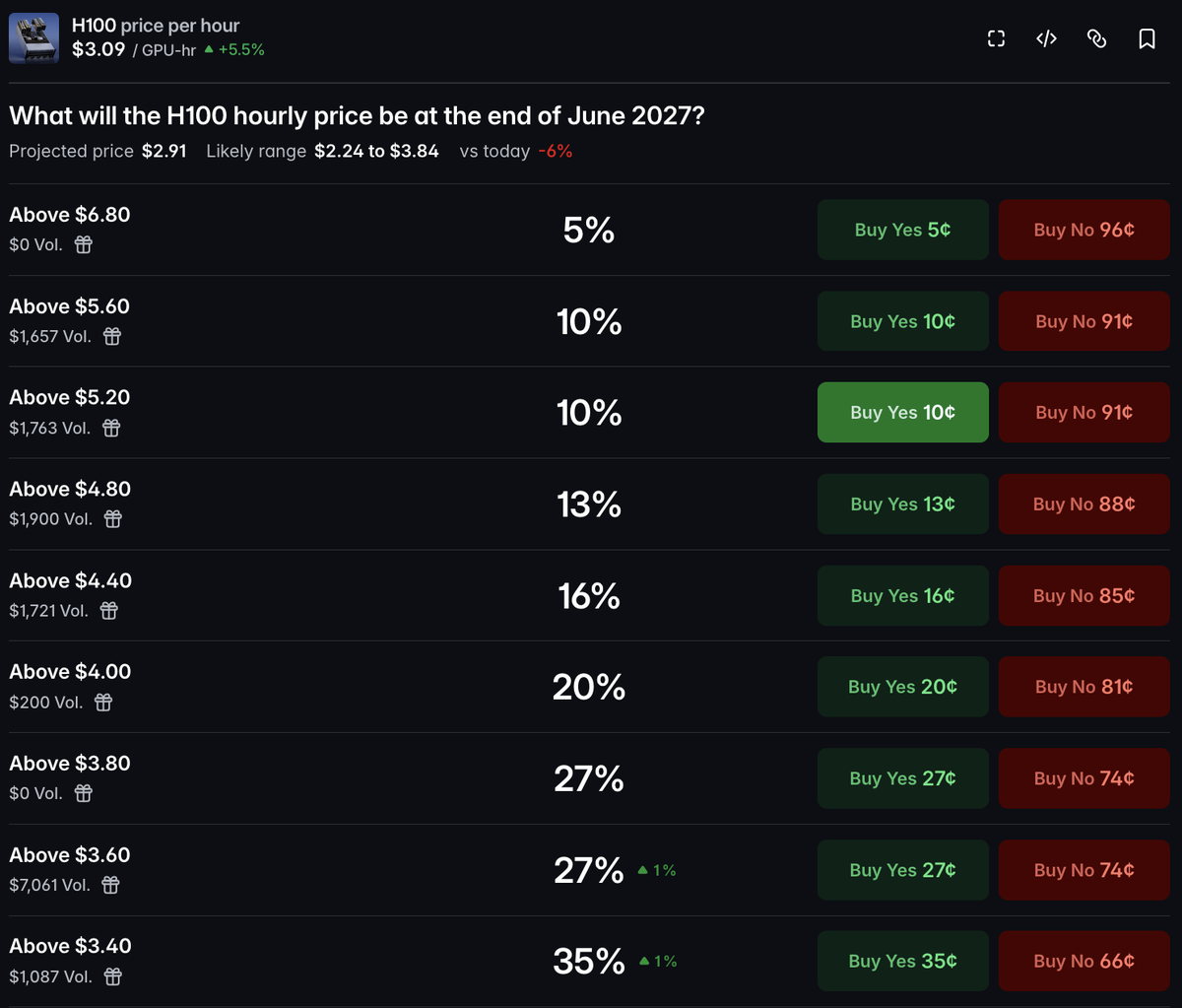
Polymarket reads the prices of a month’s strikes as a probability distribution and turns it into two numbers: a projected price and a likely range. In the June 2027 H100 ladder above, the projected price is $2.91 and the likely range $2.24 to $3.84, about 6% below today’s price. It calls the projected price the PIRP, or Polymarket-implied Rental Price.
Join each month’s PIRP together and you get the forward curve. On November 25 it sloped down for the H100, from $3.09 today to $3.01 for December 2026, $2.91 for June 2027 and $2.15 for December 2028, 30% lower. The market expects older chips to get cheaper as newer ones arrive. The “All chips” view puts the three curves side by side:
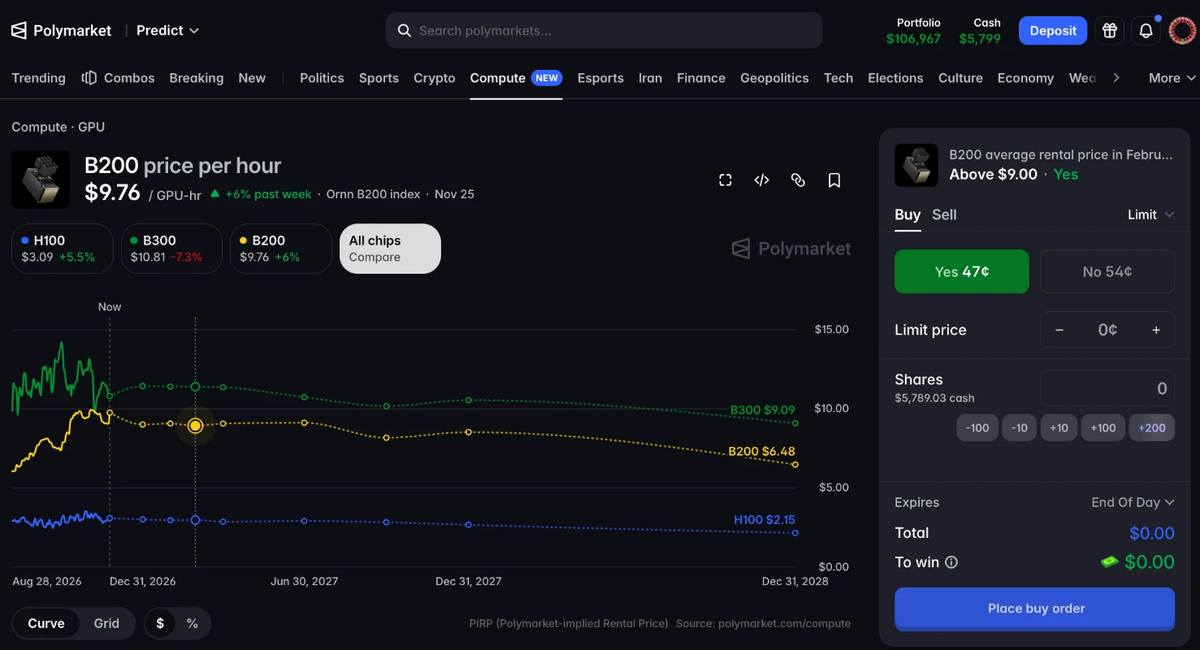
To trade, you don’t buy the curve itself. You pick a month, pick a strike and buy Yes or No. If you think H100 rents will hold up better than the market expects, buy Yes on a strike above the projected price for a month in 2027 or 2028. If you think they will fall faster, buy No.
The Index Behind the Markets
Every compute market settles on an Ornn Compute Price Index (OCPI): OCPI-H100, OCPI-B200 or OCPI-B300. Ornn publishes a daily settled value for each at data.ornn.com, measured in dollars per GPU-hour.
The settlement rules, from the market descriptions:
- The average is the arithmetic mean of the finalized daily settled values dated within the month, rounded to the nearest cent.
- A daily value is final once the next day’s value is published. Later revisions don’t count.
- Late or wrong data: if Ornn publishes a clearly erroneous value, the market can stay open for up to seven days for a correction. If values still aren’t final seven days after the month ends, it settles on the final values available.
- If the index disappears or its method changes materially, another credible source of rental price data is used, and failing that the market settles 50-50.
Polymarket’s first GPU markets, in early 2026, settled on Silicon Data’s H100 index. Its compute markets now use Ornn. Ornn is backed by a16z crypto and Galaxy, and ICE has picked its index for its own planned futures.
What Moves GPU Rental Prices
Rental prices follow supply and demand for AI compute. The Compute page lists related markets with live odds, and they’re a good map of the risks:
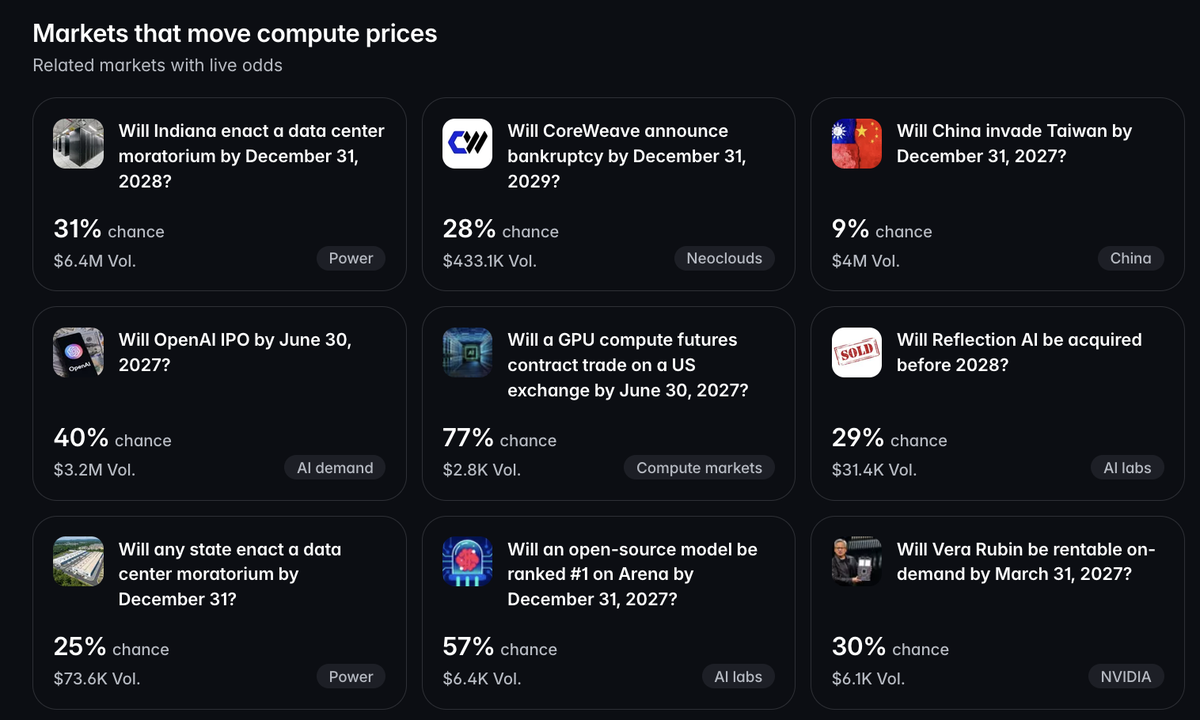
- Power and data centers. State moratoriums on new data centers would slow new supply and push rents up.
- Neoclouds. Firms like CoreWeave rent out GPUs. A failure would dump capacity on the market.
- Geopolitics. Nvidia’s chips are made in Taiwan, so a conflict there is the biggest supply risk of all.
- New chips. When Nvidia’s next generation, Vera Rubin, becomes rentable on demand, older chips usually get cheaper.
- AI demand. Big funding rounds and IPOs at the AI labs mean more training runs and more demand for compute.
Trading in Size: Request a Quote
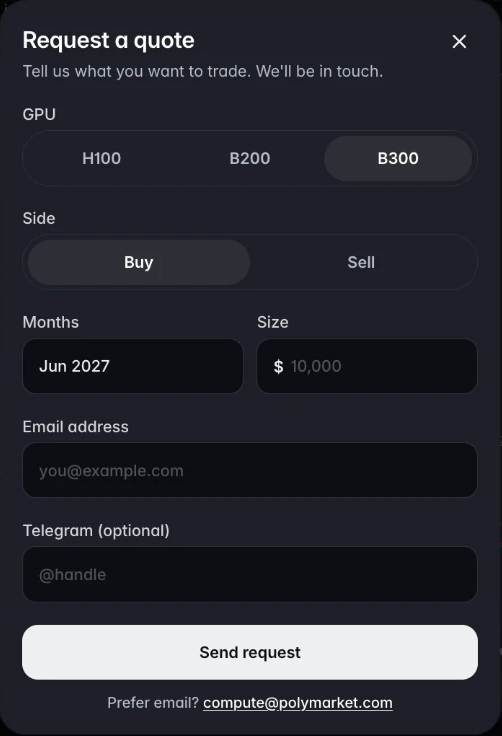
The order books on each strike are fine for small trades, but some strikes have little volume. For bigger positions, Polymarket offers a request-a-quote service on the Compute page. You choose the GPU, the side, the months and the size, and Polymarket comes back with one price for a block, a whole ladder of strikes or a strip of months. You can also email [email protected].
This is aimed at firms with real compute exposure: AI labs and startups that rent GPUs, and neoclouds that rent them out. In June 2026 Polymarket closed its first institutional block trade on the Ornn H100 index, between the prime broker FalconX and AneraLabs, and FalconX said it would act as a market maker for future compute blocks.
Fees
The compute markets charge Polymarket’s taker fee when your order fills against one already on the book: shares × 5% × p × (1 − p). At a 50¢ price that’s 1.25¢ a share, and it shrinks towards either end. A limit order that waits on the book pays nothing, which matters on the thinner strikes. Check the cost of any trade with the fee calculator.
Compute Futures on CME and ICE
Polymarket isn’t the only exchange chasing this market:
- CME Group and Silicon Data announced the first regulated compute futures in May 2026: monthly contracts on H100 and B200 rental indexes, each the size of one GPU rented for a month (730 GPU-hours), cash settled. CME set October 5, 2026 for the launch, pending regulatory review.
- ICE and Ornn announced GPU compute futures on Ornn’s index in May 2026. In a notice at the end of September, ICE said no listing date had been set.
- Kalshi lists GPU rental markets on the same Ornn index, but you need to pass its KYC checks, and it is closed to 55 jurisdictions, including the UK, Canada and Australia.
Polymarket has a market on this too: “GPU compute futures traded in the US by…?”. On November 25 it priced a 7% chance that a GPU compute future trades on a regulated US exchange by the end of 2026, and about 75% by June 30, 2027. Until those exist, prediction markets are where most people can trade compute prices.
How to Start Trading Compute
- Sign up for Polymarket: it takes about two minutes. How to sign up walks through it.
- Deposit with crypto or a card.
- Open the Compute tab, pick a GPU and a month, then pick a strike and buy Yes or No.
- Use limit orders on strikes with little volume, and request a quote for anything large.
Polymarket’s availability depends on where you live, so check your country first. For another market on the AI boom, see private company valuation markets, where you can trade OpenAI’s valuation.